3D Rendering Trends for Architecture in 2027
The 3D rendering trends already in use in architectural visualization, checked against vendor sources and our October 2026 study of 376 published prices from 130 sources.
In this article
- Our October 2026 study of 376 verified prices found that published prices vary several times over between regions.
- AI already runs inside production tools such as denoisers, but only a model built from drawings can be checked against them.
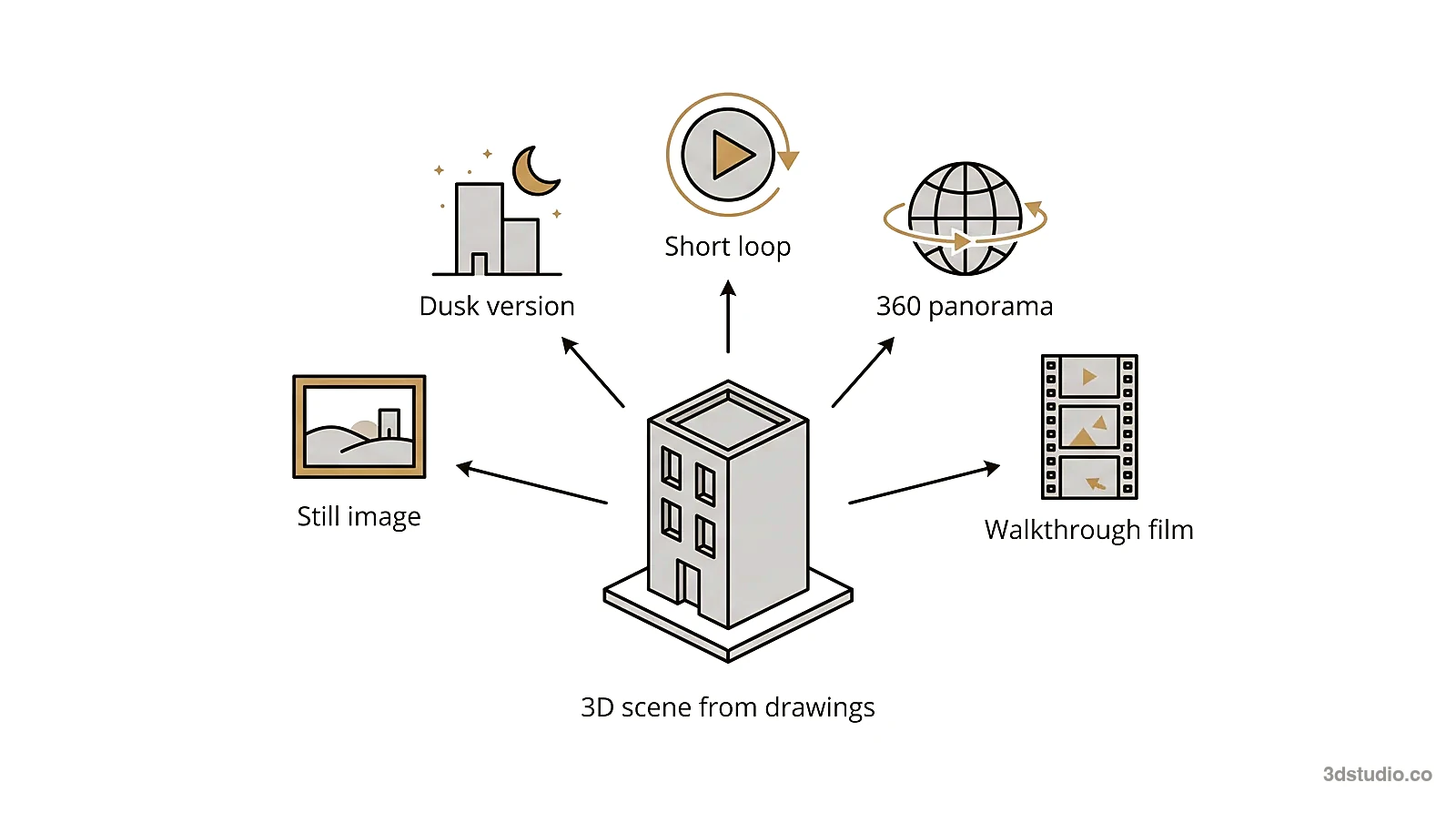
- Short loops, 360 panoramas and dusk versions all come from the same 3D scene as the stills.
- Agree the camera, time of day and clip formats at the clay model stage, while changes are cheap.
The main 3D rendering trends for architecture in 2027 are AI inside production tools, short video loops, 360 panoramas, real-time design reviews, lived-in scenes, dusk and seasonal versions, and sustainability detail taken from the drawings. Most of them change what you can order from one 3D scene, not how the building is modeled.
This list covers changes already in use in architectural visualization, not forecasts. Each section says what the trend is, where it helps and what to ask a studio before you order it. Software claims are checked against the vendor’s own pages, and market claims come from our own price study. For what a full project includes, see our architectural visualization service.
- AI in 3D rendering: built into denoisers and material tools, and used for concept images, but not for checked geometry
- Short loops and motion stills for websites, sales screens and social feeds
- 360 panoramas that open in a browser or a headset
- Real-time rendering for live design reviews
- Lived-in scenes with natural people and activity
- Dusk, night and seasonal versions of the same view
- Sustainability shown from the drawings, not added as decoration
Last updated: October 2026
What our data shows
This article rests on 2 sets of first-hand data. The first is our own production work. Since 2013, 3Dstudio.co has completed 1,247 projects for 215 client companies in 17 countries, and 125 of 220 clients came back for another project.
The second is our 3D rendering cost study 2026, published in October 2026. We collected 376 verified prices from 130 sources in 29 countries: studio price lists, freelance marketplaces and industry price guides. Every price was checked again on the live page before it was counted. The study found 4 patterns that matter for the trends below:
- Region: for exterior and interior stills, typical published prices vary several times over between regions. They are highest in Western Europe and North America, and lowest in Eastern Europe and the Baltics and among offshore studios in India and Asia.
- Spread: inside one deliverable, the highest published price is many times the lowest. An average price says little about one project.
- Units: stills are mostly priced per image and 360 panoramas per panorama. Animation is mostly priced by length, per second or per minute of film. Virtual tours and launch sets are mostly priced per project.
- Guides: for most deliverables, industry price guides quote higher typical prices than studios publish on their own price lists.
In our own projects, exterior and interior still images have been the core of the work in every period, far ahead of any other deliverable. Aerial views, 360 panoramas, 3D floor plans and animation have stayed a small part of what clients order from us. Aerial views and 360 panoramas are often ordered together with a set of stills, while animation is more often a project of its own. Over the years we see no clear shift in this mix: the main request is still a set of accurate stills built from the drawings.
The price figures and the method are in the study. This article describes the findings in words only.
AI in 3D rendering: production tools and concept images
AI sits in two different places in rendering, and each needs its own question.
Inside production tools. A ray-traced image starts out grainy, and rendering software removes that grain, called noise, with a denoiser. Some denoisers are neural networks trained on rendered images. Intel’s open source Open Image Denoise library is one example: its filters are based on deep learning, and Intel shows it on a scene rendered with Chaos Corona. Material tools use AI too. Adobe lists the Image to Material feature of Substance 3D Sampler under AI-powered scan processing: from one photo of a surface, it removes shadows and generates color, roughness, normal and displacement maps.
Steps like these clean up or speed up an image that is built from your drawings. They do not decide what the building looks like. The useful question to ask a studio is: is anything in my image generated instead of built from my drawings?
Concept images. AI image and video tools are good for exploring options and early concepts, before any 3D model exists. Depending on the tool, details such as window frames, balconies or the roofline can change or come out simpler, and nothing in the output is checked against your drawings. For images that must match the drawings (marketing, planning, a client or a jury), a studio builds the model from your CAD, BIM or PDF files and a person checks it. For quick options on your own design, our free AI rendering tool turns a screenshot of your 3D model into a photoreal image.
Short loops and motion stills for web and social
A motion still is a few seconds of one view with small movement, such as people walking, water, clouds or a slow camera push. It is rendered from the same scene as your stills, so the scene does not have to be built again. There are 3 formats:
- Repeating loop: the clip ends where it starts, so it can play on repeat on a website hero, a listing page or a sales suite screen.
- Day-to-night transition: one view that changes from daylight to dusk.
- Reveal: the grey clay model changing into the finished render.
Each format plays in a different place. A portal listing or website hero takes a landscape clip. A sales suite screen plays a loop all day. A social feed usually wants vertical 9:16. Cropping a landscape frame to vertical often cuts off part of the building, so a vertical cut needs its own framing. Decide the formats before the camera is locked.
Our price study shows how the market sells film. Most studios that publish an animation price set it by length, per second or per minute, while stills are priced per image. So ask how a short loop is counted: as seconds of film, or as part of the project. 3Dstudio.co quotes a film as one fixed price, agreed before work starts. Films are delivered as MP4, with shorter cuts on request, and the camera route of a longer film is agreed on a rough cut of the grey model first. The 3D animation service page shows what a film includes, and architectural animation cost explains how a film is priced.
360 panoramas for browser and headset viewing
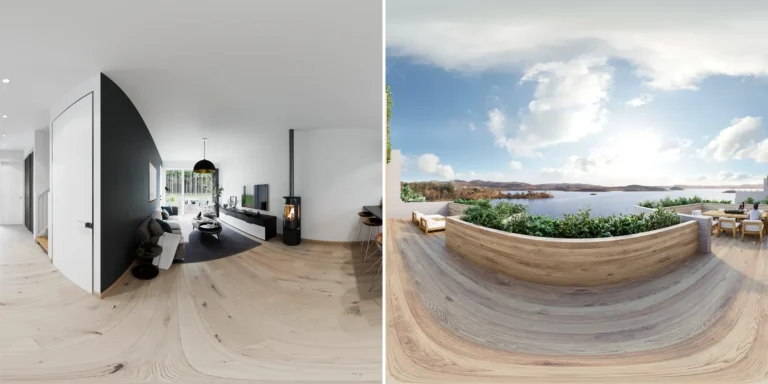
A 360 panorama is one image that shows a room in every direction from a single standing point. The viewer turns it by dragging or by moving a phone. 3Dstudio.co renders them from drawings, so a home, hotel or office can be shown before it is built. See our 360 virtual tour service for what is delivered.
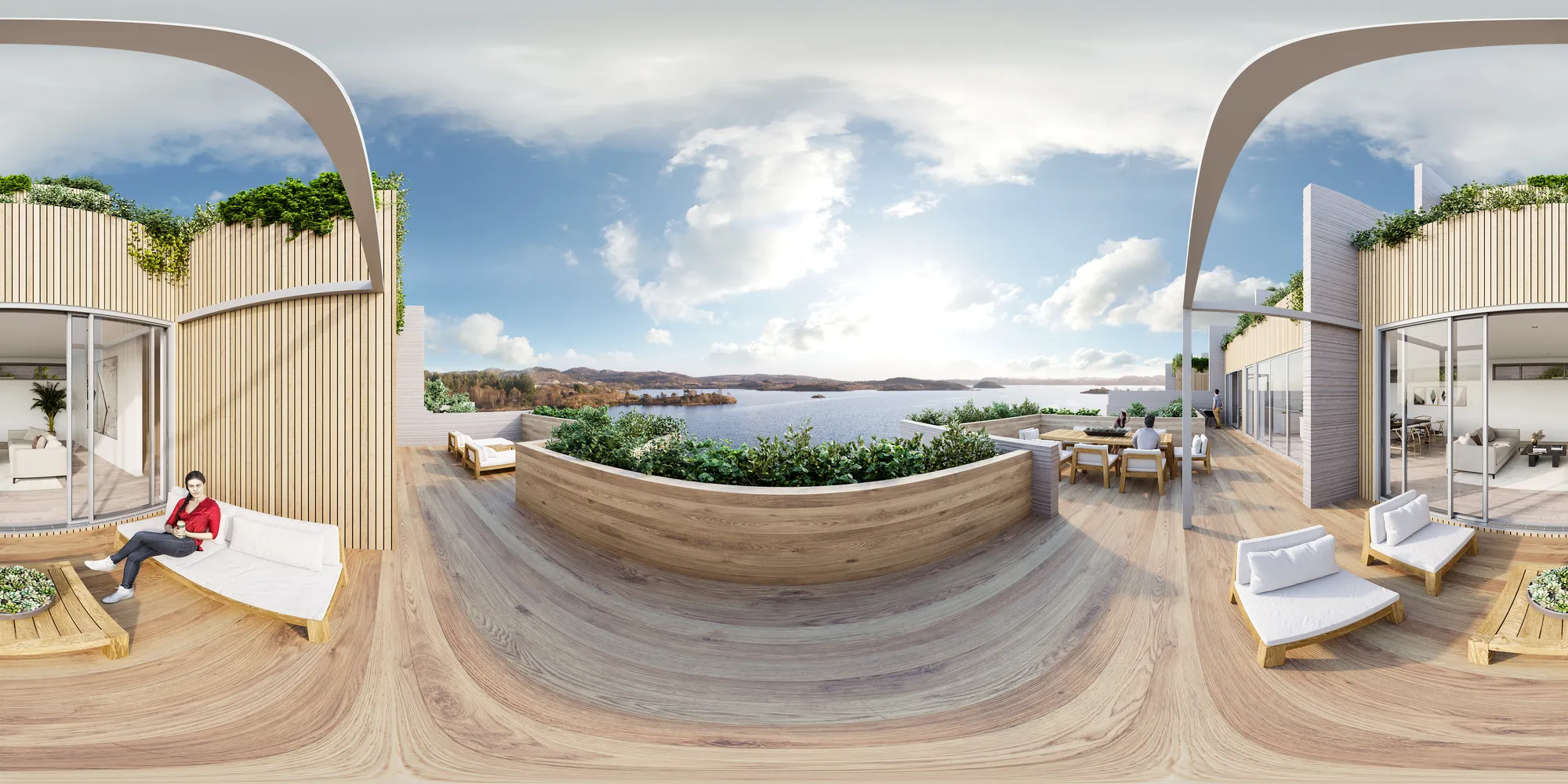
The file is a standard equirectangular image, the format 360 viewers read. It opens in a browser on a phone or laptop, and in a headset’s own viewer. Nobody needs a headset or an app. Panoramas are delivered at 4K, and larger on request. In our price study, a single panorama is usually its own line item, priced per panorama, while a linked tour is priced per project.
Three points decide whether a panorama works:
- Every direction is visible. The ceiling, the wall behind the viewer and the view out of the window all show, so furniture, materials and the outside view need to be specified all round, not only for one camera angle.
- One panorama is one standing point. Linking several into a tour with clickable hotspots is done in a tour platform. Name the platform in the brief so the files are cut to what it needs.
- A render records the design, a scan records the building. If the building already stands and you need an as-built record, a scan is the right tool. If it is on paper or about to be refurbished, a render is the only way to let someone stand in it.
Panoramas are used by off-plan buyers who cannot visit, hotel operators approving a room design and clients signing off a fit-out. For planning a full tour, read how to plan a 360 virtual tour for real estate.
Real-time rendering for design reviews
Real-time rendering draws the image live, so someone can move through a 3D scene on screen, change a material or switch the time of day during a meeting. Common tools are Unreal Engine, Twinmotion, Enscape, D5 Render, Lumion and Chaos Vantage.
Real-time suits the design stage. A team walks through a layout together, and a client sees options without waiting for a render. Offline renderers such as Corona and V-Ray spend much longer on each image. 3Dstudio.co works in 3ds Max with Corona and V-Ray.
Some real-time tools now use full ray tracing. Chaos Vantage is one example: Chaos describes it as pure ray tracing in real time, and it opens V-Ray and Corona scene files without conversion. With Vantage 3, update 3, Chaos added it to the 3ds Max viewport, so a scene can be checked in real time while it is being built.
3Dstudio.co delivers stills, MP4 films and 360 panoramas from one scene. A real-time application or a product configurator is a separate piece of software built on a 3D model. If you may want one later, ask early whether the model can be reused for it.
Lived-in scenes with natural entourage
Entourage means the people, cars and pets in a render. It looks staged when everyone stands still and faces the camera. It looks natural when people do ordinary things: someone reading by a pool, a resident crossing a room, cyclists on a path.
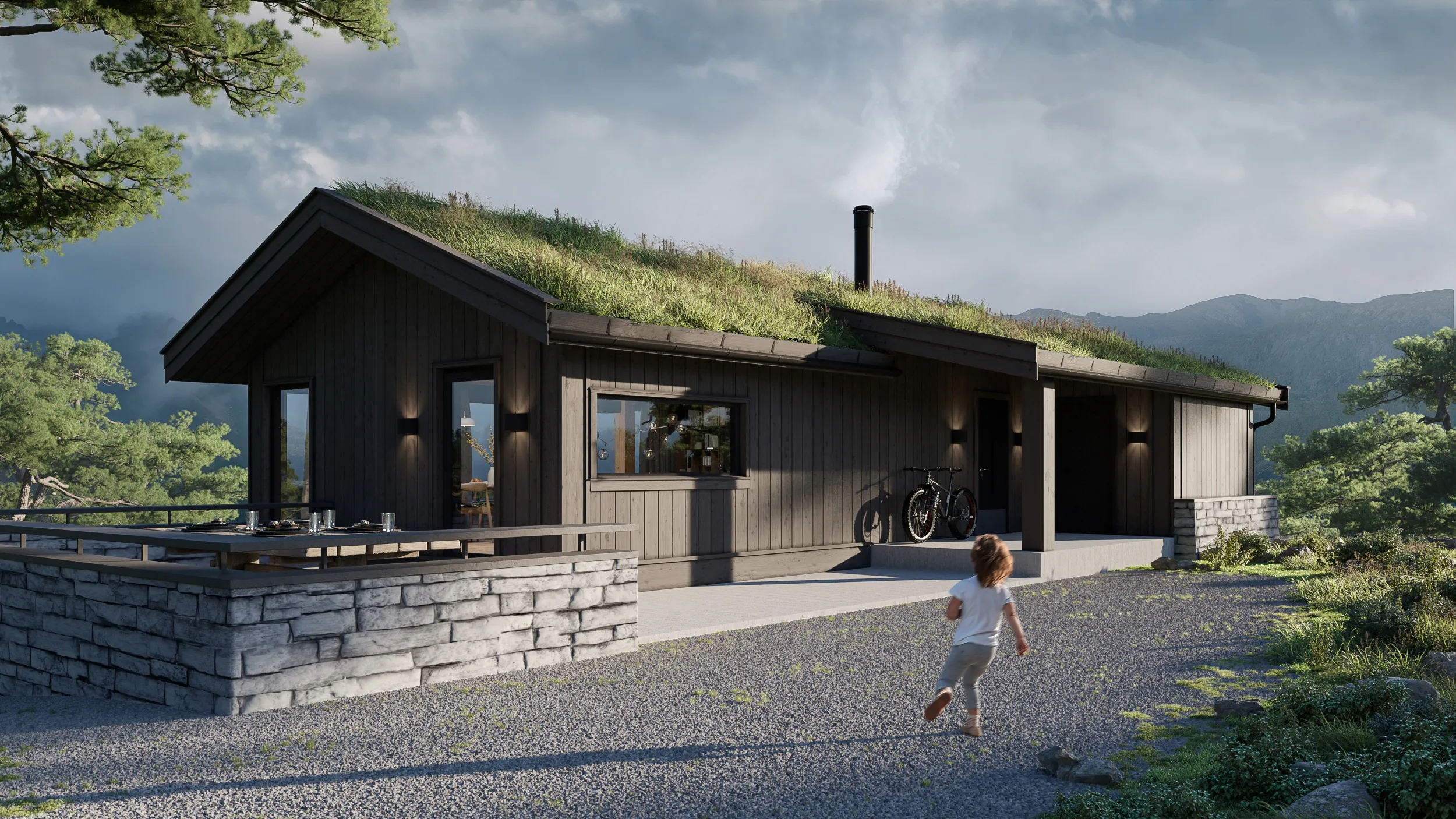
People in a render show scale and how a space is used. This matters most in property marketing and off-plan sales, where buyers cannot visit the building. Four checks keep it believable:
- Use a few well-placed people, not a crowd.
- Match them to the real use of the building: families at a home, staff and visitors at an office.
- Keep the activity plausible, with people walking at walking pace and facing where they are going.
- Check the scale: a person next to a door should match the door height in the drawings.
Dusk, night and seasonal versions
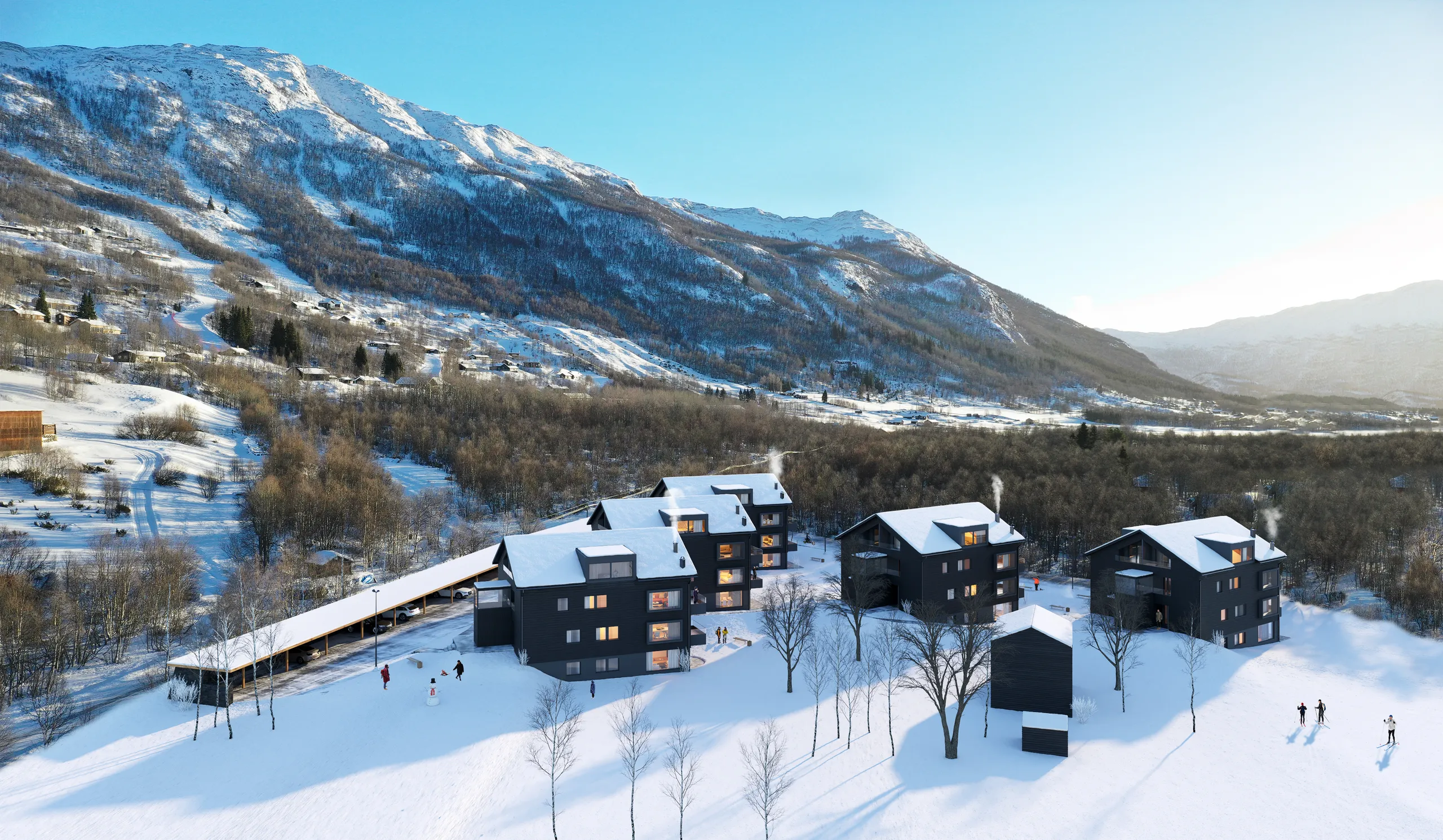
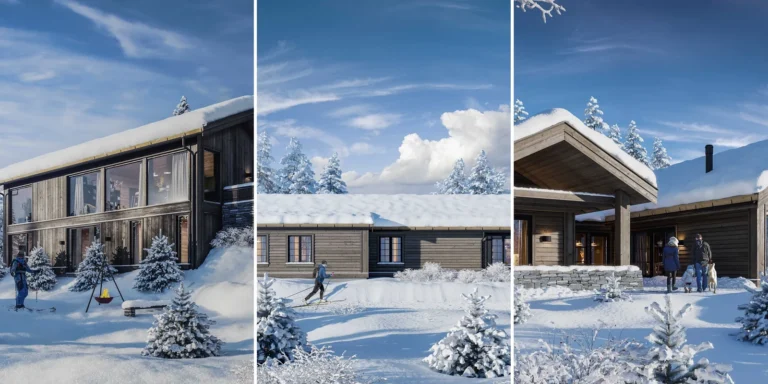
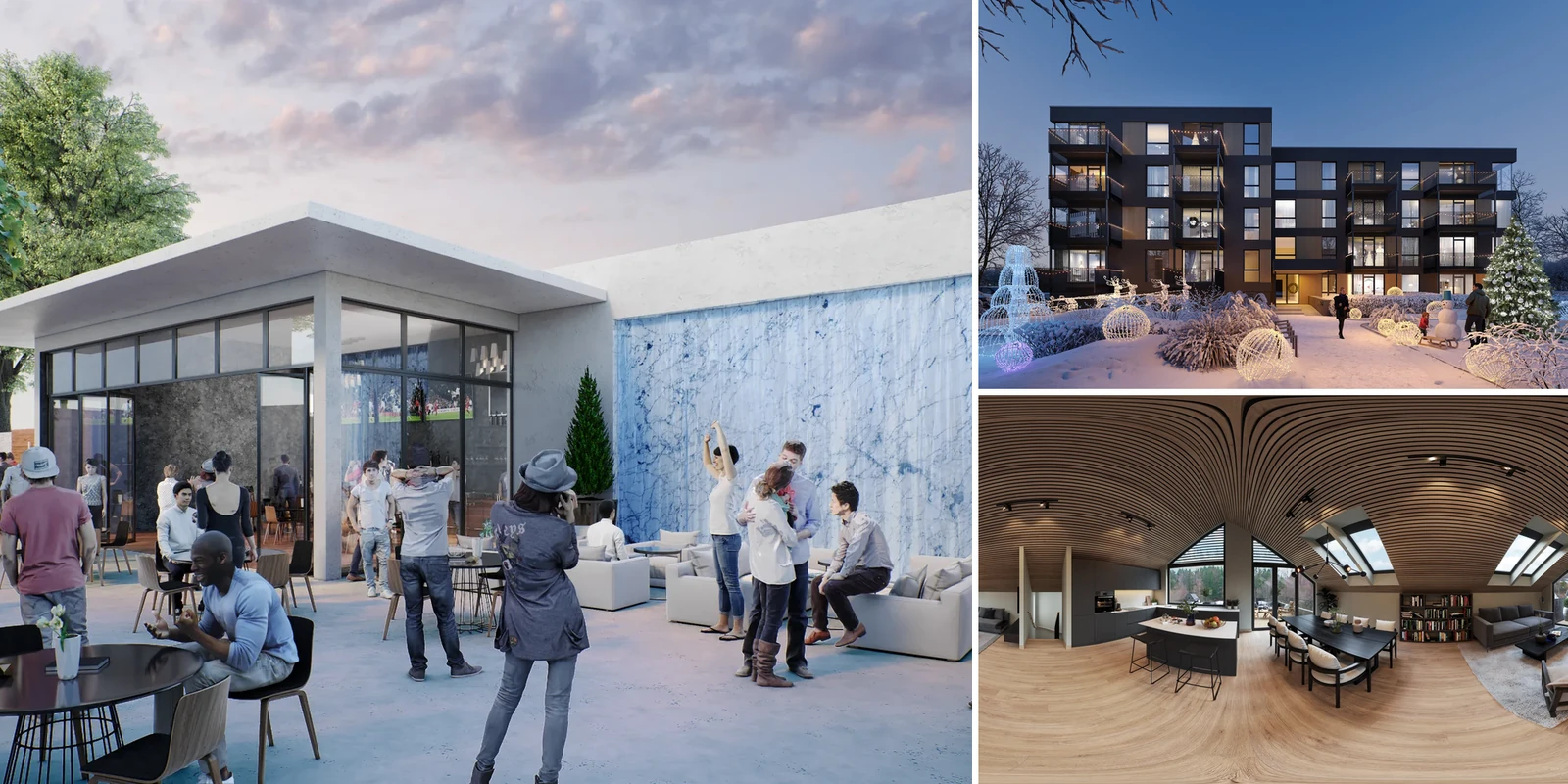
One camera view can be ordered in more than one condition: day, dusk or night, and sometimes a winter version. A dusk view shows how a facade looks once it is lit from within. A snow view shows the building in a different season.
The building model and the camera stay the same. A dusk or night version changes the light and the sky. A snow version also adds snow and changes the planting, which is more work than a change of light alone. Either version still costs much less than a first view built from nothing, because the scene already exists. See our exterior rendering service for the views we produce.
Sustainability shown from the drawings
A render can only show sustainability features that are in the drawings: real glazing, real material callouts and real planting plans. Show them plainly. Plants or green surfaces that the design does not include are decoration. They are not a sustainability feature.
One distinction matters. A render can use the real location, date and hour for the sun, so shadows and daylight look convincing. That is a picture, not a daylight or energy calculation. Compliance figures come from analysis software, and the render should show what the analysis found, not replace it.
Daylight, materials and planting belong in the files you send for a quote, not in a request made after the scene exists. Interiors with plants, daylight and natural materials are often called biophilic. Our interior rendering service shows how they look in a finished space.
Which trends fit which project stage
| Stage | What helps | Typical deliverable |
|---|---|---|
| Concept | AI mood images, grey clay model views to test the massing | Mood images, clay model views |
| Design review | Real-time walk-through of the model, camera and time of day agreed on the clay model | Live session, clay model views |
| Planning | Views built from the drawings and checked by a person | Stills, sometimes a film |
| Marketing launch | Dusk version, lived-in scenes, short loops | Stills, MP4 loop |
| Sales | 360 panoramas of key rooms, a loop for the sales suite screen | 360 panoramas, MP4 |
By buyer:
- Architects: concept images and clay model views early, real-time reviews in the design stage, checked stills for planning.
- Real estate developers: stills with a dusk version, a loop for the sales suite, 360 panoramas of the key rooms.
- Interior designers: 360 panoramas and stills that show daylight, planting and materials for client sign-off.
- Estate agents: lived-in stills, a short loop for the listing and 360 panoramas for buyers who cannot visit.
Agree versions and formats at the clay model stage
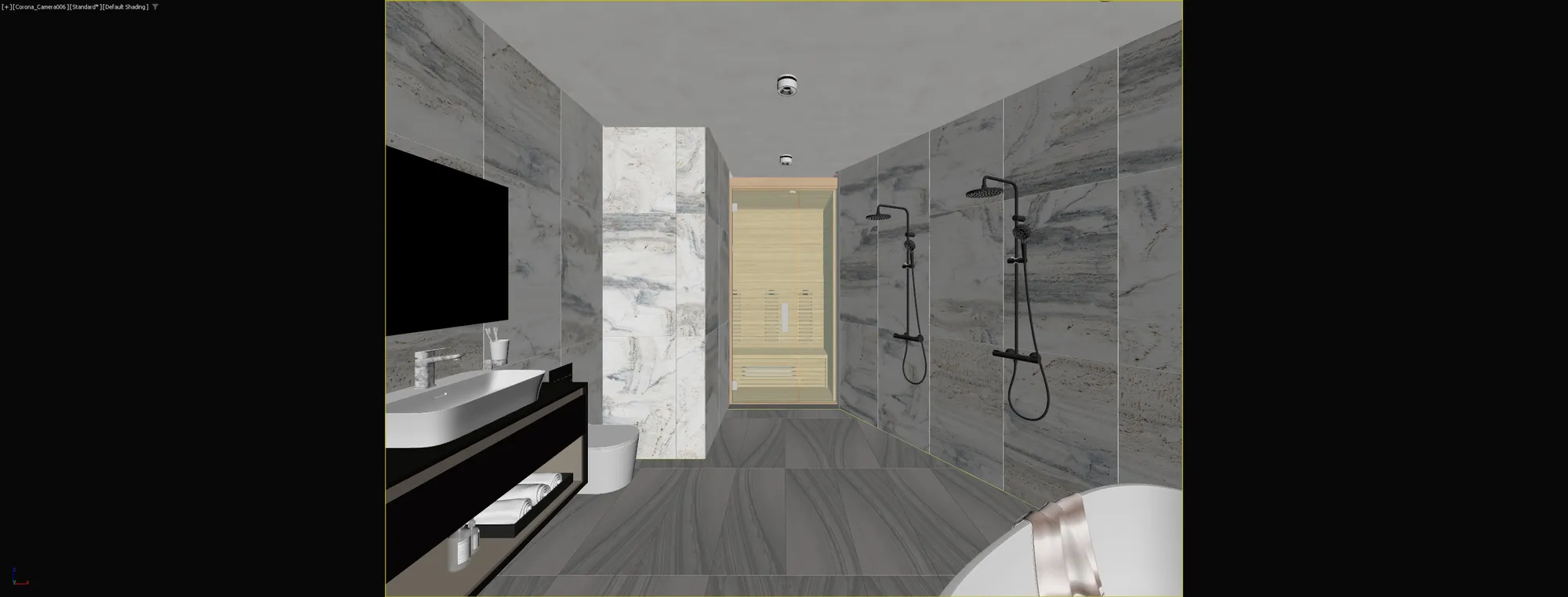
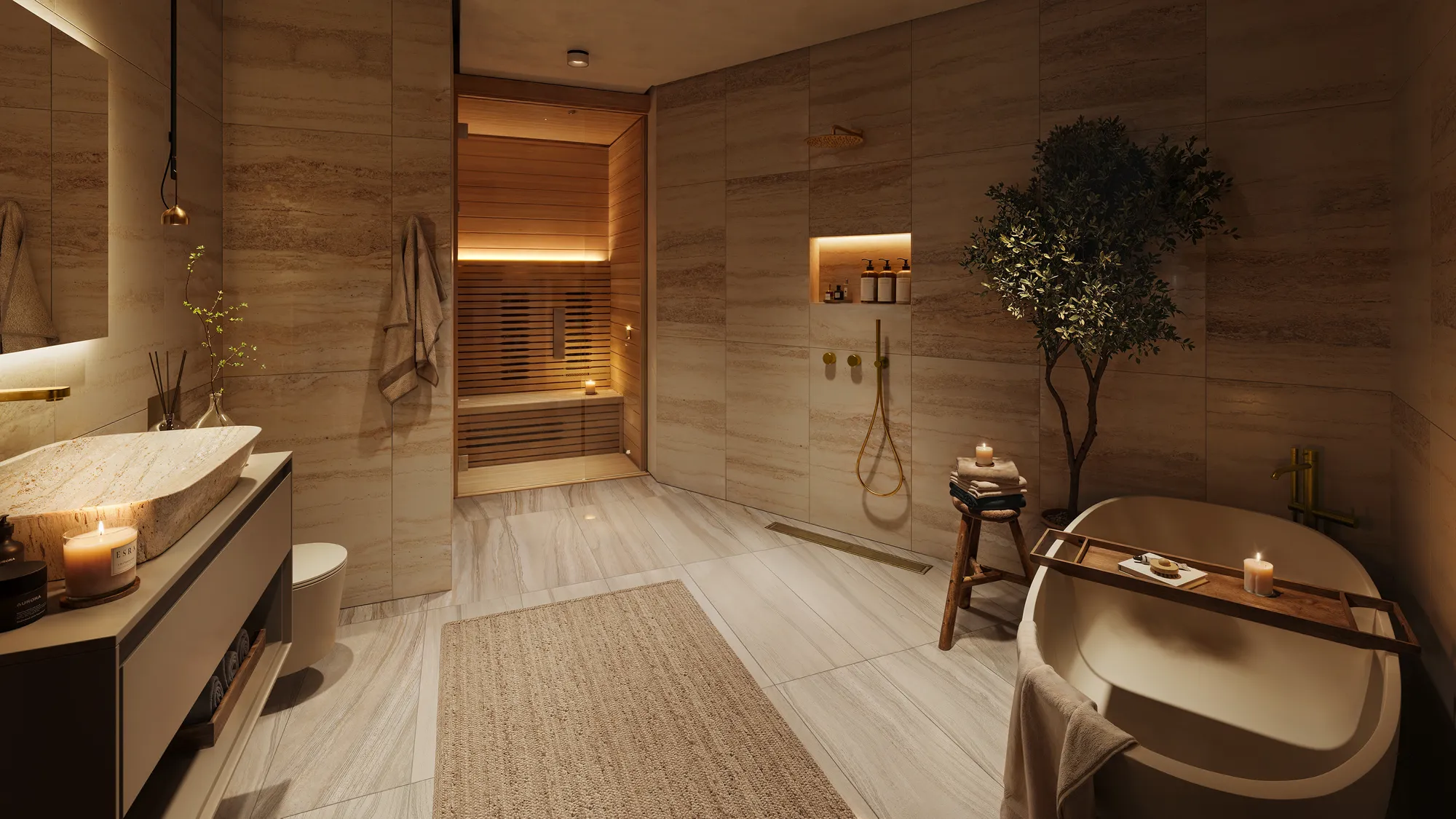
The clay model is an untextured grey 3D model, built before any material or light work starts. The camera, lens, height and time of day are agreed at this stage, together with any dusk, snow or loop version, while changes are still cheap. See how a project runs from upload to delivery for the full sequence.
Tip: Decide the time of day, the season and the clip formats at the clay stage. Adding a dusk, snow or vertical version after the final image is locked costs more than agreeing it upfront.
What changed this month
This article is updated every month. Each update adds a dated entry here.
- October 2026: On 15 October we published our 3D rendering cost study 2026, with 376 verified prices from 130 sources in 29 countries. Its findings are summarized in the section “What our data shows”.
Questions about 3D rendering trends
Can ChatGPT do architectural renderings?
It can make a mood image from a text prompt or a sketch. It does not build the image from your CAD or BIM files, and nothing in the output is checked against your drawings. That is fine for exploring an early direction. For planning or sales material, a studio builds the model from the drawings and a person checks it.
Is real-time rendering as good as V-Ray or Corona?
For live design reviews and fast options, yes, and some real-time tools, such as Chaos Vantage, now use full ray tracing. Offline renderers such as V-Ray and Corona spend more time on each image, which gives more room for light and fine detail in final stills. Both can start from the same 3D model.
Do buyers need a VR headset to view a 360 panorama?
No. A rendered 360 panorama opens in a browser on a phone or laptop. A headset is optional and uses its own viewer.
What is Gaussian splatting in architectural visualization?
It is a way to turn many photos or a video of a real place into a 3D scene. A new building can then be placed into that captured street or landscape. Chaos Vantage, for example, can render environments made from real-world captures this way. The result is visual context, not a measured survey, so it does not replace site drawings. At 3Dstudio.co, the drawings give the building, and photos or a map give the surroundings.
Does a dusk or snow version change the price?
Yes, but it costs much less than the first view, because the scene already exists. A snow version changes more of the scene than a dusk version, so it costs more than a change of light. Rendering is priced per project as one fixed price, and the pricing page shows what moves the number.
Diagrams in this post are drawn with an AI image tool from our brief and checked by our team.