How to Outsource 3D Rendering: In-House vs Freelancer vs Studio
When to outsource 3D rendering, how in-house, freelancer, studio and offshore team compare, what it costs, and how to hand over and test a first project.
In this article
- Outsourcing pays off when rendering work comes in peaks and nobody on your team renders full time
- A freelancer, a studio and an offshore team differ in who manages the work, peak capacity and consistency
- A clean handover means clear files, one named contact, specific feedback and a deadline tied to your schedule
- Every delivered image comes with full usage rights, while the 3D scene stays with the studio
When you outsource 3D rendering, you send an architectural visualization project to an outside studio instead of building the images with your own staff and software. It pays off when your rendering work comes in peaks (a launch, a competition entry, a planning submission) and nobody on your team models and renders full time.
You have 3 outside options: a freelancer, a rendering studio or a dedicated offshore team. The comparison table below sets them against an in-house artist. Projects start at €1,000. A single-building launch set typically costs €3,000 to €6,000. Multi-building developer packages typically run €5,000 to €15,000. See how 3Dstudio.co prices a project.
3Dstudio.co is an architectural visualization studio, so this guide is written from the studio side. It also says when a studio is the wrong choice.
In-house, freelancer, studio or offshore team: how they compare
Choose by your workload pattern and by how much management time you can spare. Price per image is the weaker guide.
| In-house 3D artist | Freelancer | Rendering studio | Dedicated offshore team | |
|---|---|---|---|---|
| Fixed costs | Salary, software licenses, workstation | None | None | A recurring team fee |
| Who manages the work day to day | You | You | The studio | You |
| Workload peaks | Only up to the size of the team | Limited to one person’s capacity | Yes, if booked early (3Dstudio.co takes a limited number of projects each month) | Only if you add staff to the team |
| Consistency across a set of views | Depends on one person | Depends on one person | Set by the studio’s process and review stages | Depends on how well you manage the team |
| Confidentiality | Internal | Ask for an NDA before sending files | Ask for an NDA (3Dstudio.co works under NDA as standard) | Set by the contract |
| Best for | Steady weekly volume | One simple image or a small one-off task | Project peaks: launches, competitions, planning submissions, multi-view sets | Long-term high volume that your own staff can manage |
In-house. An in-house artist makes sense when rendering is a weekly task across several live projects. The cost is fixed and the person knows your projects. The risks are idle time in quiet months and no cover when that person is away.
Freelancer. A freelancer is one person. That suits one simple image or a task you will review closely. Ask who covers the work if they are ill, how revisions are handled and whether they sign an NDA. The quality of a full set depends on one person’s time.
Rendering studio. A studio runs the production for you, in stages with review points. 3Dstudio.co is in this column: one fixed price and a delivery date are agreed before work starts. A studio fits peaks, when you need several views at once and nobody to manage the production.
Dedicated offshore team. This is a group of production staff in another country who work on your projects under your direction. You get capacity without hiring locally, but you manage the briefs, the review and the consistency. The recurring fee suits steady work better than a one-off launch.
In-house vs outsourced 3D rendering: what changes
In-house rendering is mostly a fixed cost. Outsourced rendering is a cost per project.
| Cost or risk | In-house | Outsourced |
|---|---|---|
| Software licenses | A 3D package, a render engine and an image editor, with recurring license fees | Included in the project price |
| Workstation and render hardware | Bought, then replaced as scenes get heavier | Included in the project price |
| Staff time | Salary is paid in quiet months too | Paid per project |
| Training | Takes time away from the person’s main job | None needed |
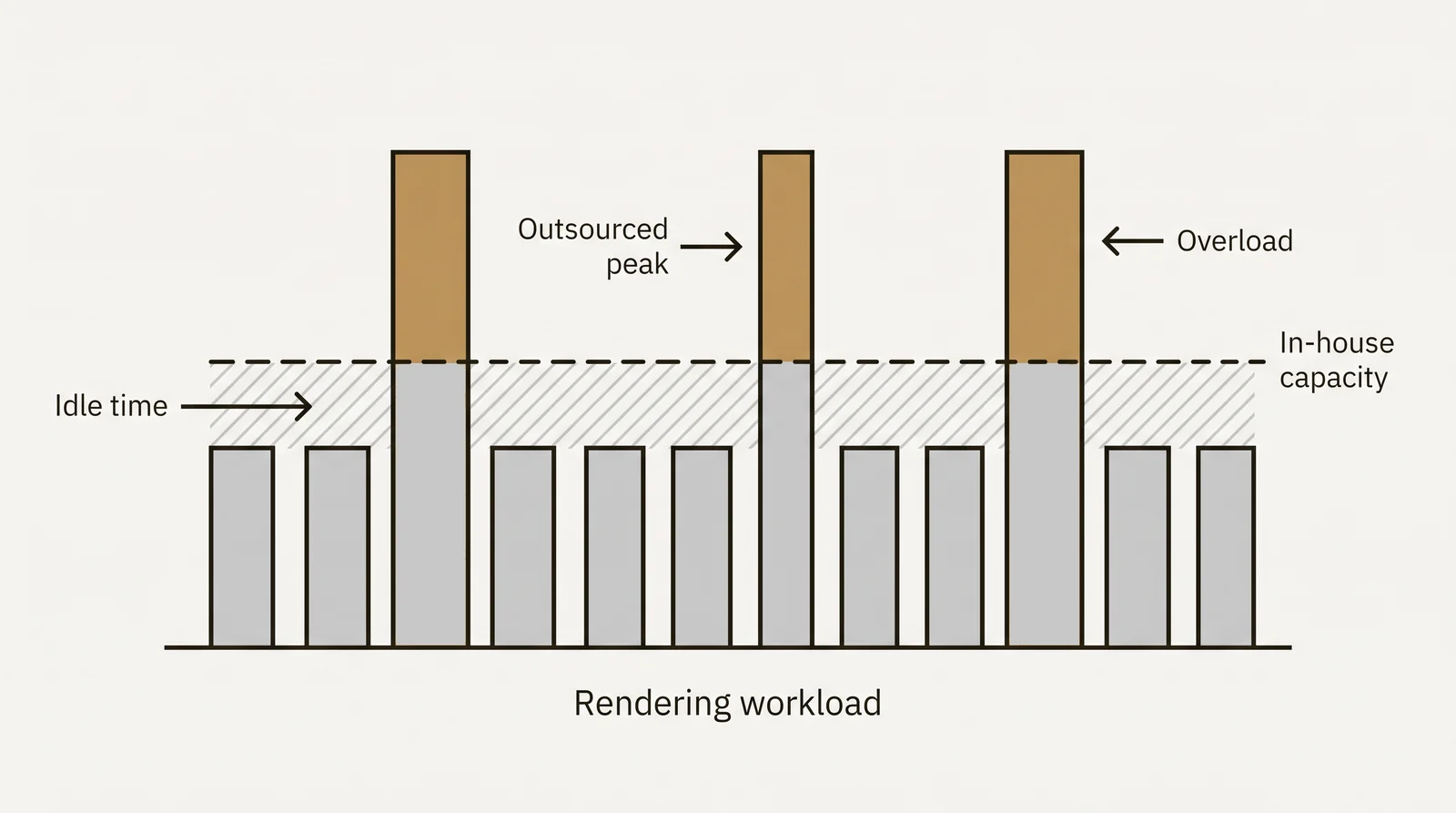
| Workload peaks | The team is overloaded in a peak and idle after it | Moved to the studio |
| Skill range | One person’s strengths | Several types of work from one supplier (3Dstudio.co covers interiors, exteriors, aerials, floor plans and animation) |
Rendering demand in an architecture or property firm is often uneven. A launch, a competition deadline or a planning submission creates a spike, followed by weeks with none. A team sized for the quiet weeks falls behind in the spike. A team sized for the spike sits idle the rest of the time. Outsourcing moves the peak to a studio. Book early, because 3Dstudio.co takes a limited number of projects each month.
One in-house 3D artist is usually strongest at one type of work, such as interiors, exteriors or floor plans, and less practiced at the others. A studio that covers several types of rendering can take a wider mix of requests without a new hire for each one.
What outsourcing 3D rendering costs
At 3Dstudio.co, projects start at €1,000. A single-building launch set typically costs €3,000 to €6,000. Multi-building developer packages typically run €5,000 to €15,000.
Each project gets one fixed price, agreed before work starts. It is not priced per image.
These things move the price of an outsourced project:
- The number of views
- The size and complexity of the scene
- How ready your files are
- Resolution and format
- How much art direction and styling you need
- Whether the scene already exists from earlier work
The first view of a scene carries the cost of building it. Further views of the same scene cost much less. If your budget is fixed, we do not discount the same scope. We rescope: fewer views, one hero shot instead of a set, or standard resolution instead of large format. The 3D rendering cost guide explains how a quote is built.
When outsourcing 3D rendering makes sense and when it does not
Signs outsourcing makes sense
- Rendering needs are occasional or tied to specific milestones, not a constant weekly volume
- A launch, competition entry or planning submission needs several views at once (see pre-construction marketing renderings)
- Nobody on staff models and renders as a main part of their job
- You need a specialist output, such as a section cut or a full set of floor plans, that would take a generalist longer to learn
- You need a delivery date agreed before work starts, not an estimate that can slip
Signs it does not make sense
- Your team already produces renderings every week across several live projects, with staff and software fully used
- The building design is still changing daily, so any visual investment would be reworked before it is useful
- The images must be produced inside a closed internal system that files cannot leave
Architects often fall on the outsourcing side of this list: a practice that needs a few renderings a year for planning submissions rarely has enough volume to justify a dedicated 3D artist. See how this fits a typical workload on our page on 3D rendering for architects. If you are choosing between named studios rather than deciding whether to outsource, read how to compare 3D rendering companies.
AI rendering tools vs outsourcing to a studio
AI image and video tools are good for loose mood images and early concepts. They do not hold a building’s geometry, so window counts, balconies and rooflines can drift from the drawings. Nothing in the output is checked against the drawings. A studio model is built from the drawings and checked by a person.
Use an AI tool for an internal mood image while the design is still open. Use a studio for a planning submission, for sales material, and for anything a buyer or an authority will compare with the drawings.
How to hand over a project to a rendering studio
A clean handover starts with sending what already exists, not with a meeting. 3Dstudio.co can quote from partial drawings, even from a photo of a hand sketch. Useful files include:
- CAD files (.dwg)
- PDF plans and elevations
- SketchUp, Revit, ArchiCAD or 3ds Max files
- IFC or other common 3D and BIM formats
- Material specs and mood or reference images
- A photo of a hand sketch, if nothing more finished exists yet
If a reviewer on your side has no CAD software, convert the DWG to PDF first with our free DWG to PDF converter, so they can check what you send.
Name one person on your side who can answer questions about the brief and approve each stage. A rendering project moves through a few short checkpoints (camera position, materials, lighting). Routing questions through several people slows down every one of them. Ask who your point of contact is on the studio’s side too, before you send files.
Set the delivery date against your own submission schedule. At 3Dstudio.co, a single view takes about a week, and a medium-to-large set takes 2 to 3 weeks. Build in time before your submission or launch date for review and sign off, not only for delivery. If we miss the agreed delivery date, the set is free.
Tip: Send files as soon as they are stable enough for a quote. Waiting for finished drawings only delays your own delivery date, since the studio still needs its own time after you send them.
This is the process we use at 3Dstudio.co, in 4 stages. Read more on how our process works:
- Upload your files. The brief is built from what you send, without a discovery call or a questionnaire, and you get a fixed price and delivery date back within 30 minutes.
- Grey model: an untextured 3D model is built, and camera position, lens, height and time of day are agreed while changes are still cheap.
- First look: one view is rendered with materials, light and surroundings added, still cheap to change. Revision rounds happen at this stage.
- Final delivery in 4K, with full usage rights. Further views of the same scene reuse the existing model, so a later phase or extra angle is not priced from zero.
How to give feedback on an outsourced rendering
Good feedback is specific, comes from one person and arrives at the right stage. Every project at 3Dstudio.co includes 2 revision rounds, then refinement until sign-off.
- Grey model stage: comment only on camera position, lens, height, time of day and geometry. These are cheap to change now and costly later.
- First look stage: comment on materials, light and surroundings.
- One list: send one consolidated list from your named contact, not separate comments from several people.
- Mark up the image: draw an arrow and add a note instead of describing the spot in prose.
- Name the material: send the spec sheet or a reference image instead of a feeling such as “warmer”.
- Say what is wrong and what it should be: a problem without a target leaves the studio guessing.
Weak feedback: “Make the living room feel warmer and more modern.”
Specific feedback: “In view 2, replace the floor with the oak sample on page 3 of the material sheet. Make the sofa the dark gray fabric from reference image 4.”
Agree in writing what counts as a revision and what counts as a change of design. At 3Dstudio.co, moving the camera or changing the design after sign-off is priced as a new view, and we say which it is before doing the work.
How communication works across time zones
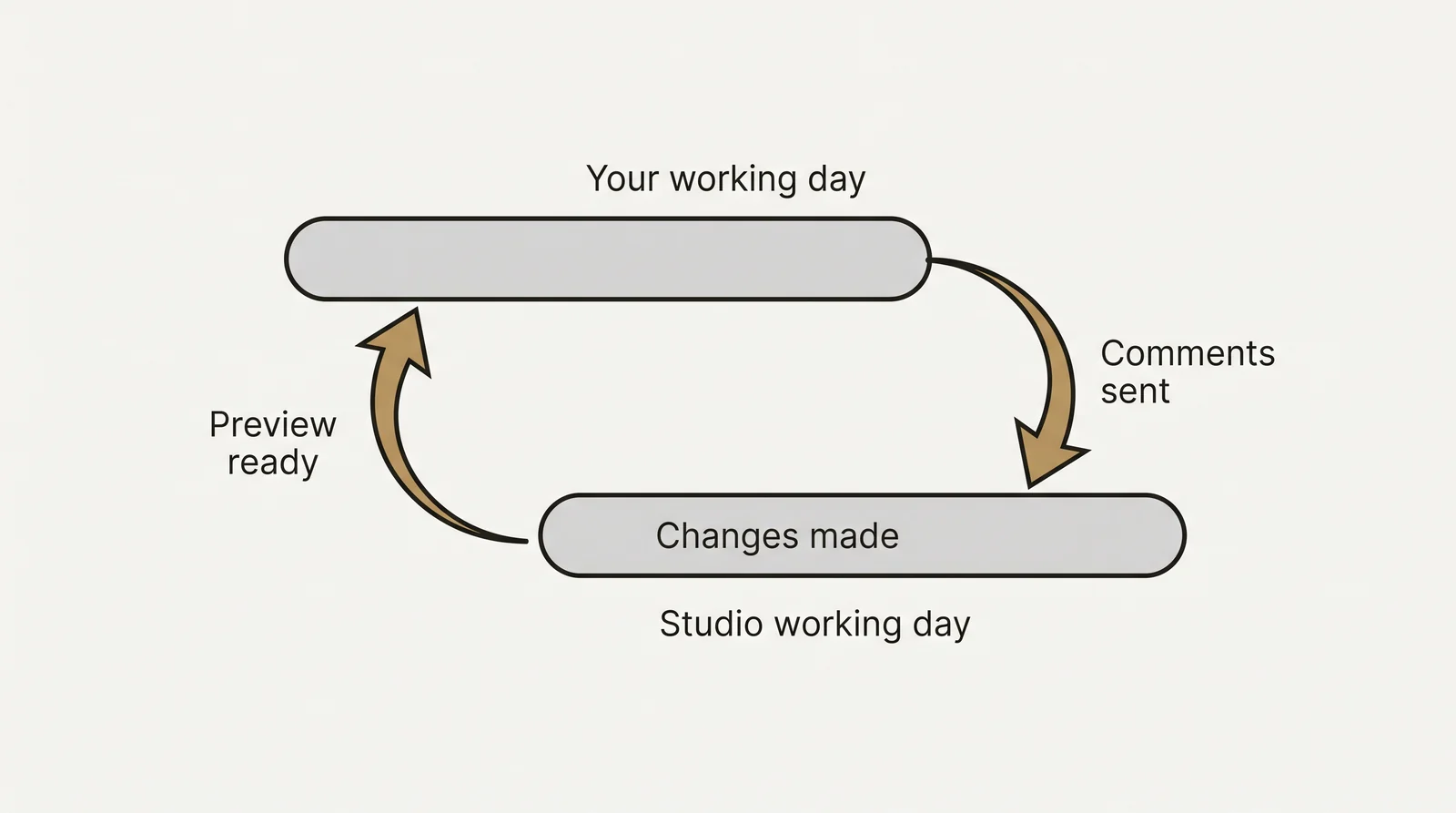
A studio in a different time zone can still turn work around quickly, because most decisions happen in writing and need no live call. 3Dstudio.co is based in Tallinn, Estonia, and has delivered work to clients in 17 countries, among them the UK, the US, Canada and Australia. The brief is built from your files, the quote is fixed, and camera position and materials are agreed at the grey model stage. All of this works over email or a shared review link.
The parts that would normally need a site visit come from the drawings, plus photos or a map of the site. Nobody has to travel.
Send review comments at the end of your working day, so the studio can act on them at the start of its day. A reply that lands the next morning still leaves room for the 2 revision rounds before delivery. If you are in the US and are weighing local studios against a remote one, see 3D rendering companies in the USA.
NDA and confidentiality for unbuilt schemes
Unbuilt buildings, off-plan units and competition entries are usually confidential before launch, so confidentiality needs to be agreed before any files are sent, not after. Ask whether the studio signs an NDA as a matter of course, and what happens to your files and the images once the project ends.
3Dstudio.co works under NDA as standard and does not publish a project without written permission. That applies to every project, including competition entries and schemes that have not been announced yet.
Ask what happens to your source files after delivery too. A studio that keeps files only for the length of the project, then removes them, is a different arrangement from one that keeps a permanent archive. Either can be right, depending on what your own confidentiality agreements require.
Usage rights to the images and who keeps the 3D scene
Ask exactly what you are buying: the delivered images, or the underlying 3D scene as well. Every image delivered by 3Dstudio.co comes with full usage rights, so you can use it on brochures, property portals, hoardings, press, social media and planning submissions without paying a license fee for each use. The 3D scene itself stays with the studio.
Usage rights and copyright are not the same thing. Ask any studio in writing which one you get, and for which uses.
Keeping the scene with the studio is what keeps a later view cheap. Once a building has been modeled, rendering it from a new angle, in a new season or with an updated layout does not start from zero. A later phase with 3Dstudio.co starts from the existing model. A different studio would have to work from your drawings again, unless it is given the scene files.
If your project will need further images over time, such as a phased development with several launches, ask how the studio handles repeat requests. Our page for 3D rendering for real estate developers covers phased projects.
What goes wrong when outsourcing 3D rendering, and how to prevent it
| Problem | How to prevent it |
|---|---|
| The drawings change after the first look | Freeze the geometry at the grey model stage. Tell the studio as soon as a change is confirmed. |
| Several people send conflicting comments | Name one contact who sends one consolidated list. |
| You look for a studio when the deadline is already close | Shortlist studios early and test one with a single view before you need a full set. |
| The work is passed to people you never hear from | Ask who models and renders your project and who checks it against the drawings. |
| The portfolio shows only single hero shots | Ask to see a full project set. |
| You get an estimate instead of a price | Ask for a fixed price and delivery date in writing, and for what happens if the date is missed. |
| Your files leave your control | Agree the NDA before you upload, and ask what happens to the files after delivery. |
Run a small first project as a test
If you have not outsourced 3D rendering before, start with a single view rather than a full set. At 3Dstudio.co, a single view is delivered in about a week. That is enough to judge a studio’s process. Use the table to score the test.
| What to check in a test view | A good result | A warning sign |
|---|---|---|
| The quote | A fixed price and a delivery date, with what is included | An estimate with no date |
| Questions before modeling | Specific questions about your drawings | No questions at all |
| The grey model | Window counts, levels and proportions match the drawings | Details that differ from the plans |
| The first look | Materials and light match what was agreed | Materials or camera changed without a reason |
| Delivery | The image arrives on the agreed date | The date slips with no notice |
Look at examples of a studio’s past work before you commit, ideally a full project set rather than only its best single images. Check independent reviews rather than testimonials the studio picked itself. Our portfolio and reviews page are both public for this reason. 3Dstudio.co has worked since 2013, with 1,247 projects completed for clients in 17 countries. Of 220 clients, 125 came back for another project. We are rated 5.0 on Clutch, a platform we do not control.
Before you send a test view, check:
- You have the files listed under handover
- One named contact on each side
- Your own submission or launch date, with review time built in before it
- Whether an NDA is needed before files are sent
- Whether the price includes full usage rights
- How many revision rounds are included, and what happens after them
Get in touch with whatever files you already have and ask for a fixed price and delivery date.
Questions about outsourcing 3D rendering
How much does it cost to outsource 3D rendering?
Projects start at €1,000. A single-building launch set typically costs €3,000 to €6,000. Multi-building developer packages typically run €5,000 to €15,000. Each project gets one fixed price, agreed before work starts.
Is it cheaper to outsource 3D rendering than to hire a 3D artist?
It depends on your workload pattern, not on a price per image. A full-time artist, licenses and a workstation are a fixed cost, paid in quiet months too. Outsourcing is paid per project. If you render every week across several projects, in-house can pay off. If the work comes in peaks, outsourcing usually costs less.
Should I outsource to a freelancer or a rendering studio?
A freelancer suits one simple image, and you manage the work. A studio suits sets of views, fixed delivery dates and a process with review stages. 3Dstudio.co is a studio. See the comparison table at the top of this guide.
Can AI tools replace an outsourced 3D rendering studio?
Not for work that must match the drawings. AI tools are good for mood images and early concepts. They do not hold geometry such as window counts, balconies and rooflines, and their output is not checked against drawings. A studio model is built from the drawings and checked by a person.
How long does an outsourced 3D rendering take?
At 3Dstudio.co, a single view takes about a week, and a medium-to-large set takes 2 to 3 weeks. The delivery date is agreed with the quote. If we miss the agreed delivery date, the set is free.
What happens if my drawings change after work has started?
Tell the studio as soon as a change is confirmed. Changes are cheapest at the grey model stage, before materials and lighting are added. At 3Dstudio.co the scene is kept, so a change after delivery is a re-render, not a rebuild.
Do I need a signed agreement before sending files for a competition entry?
Ask for an NDA if the entry is not public yet. A studio that works under NDA as standard should be able to sign one before you send anything.