
Virtual Staging vs Traditional Staging: Cost, Speed and Disclosure
Which to use, what each costs over time, how fast each is, and which disclosure rules apply to virtually staged photos, including California's 2026 rule.
In this article
- Use virtual staging for vacant homes sold online; use traditional staging when many buyers visit in person; many listings use both.
- Traditional staging is a recurring rental cost. Virtual staging is a one-time cost per photo or per project.
- A virtually staged photo must be labeled, and California has required the original photo too since 1 January 2026.
- AI apps are fast but do not hold the room's geometry, so check the walls, windows and floor in the result.
Use virtual staging for a vacant home that is marketed mainly through online listings, or when the budget or timeline does not allow furniture rental. Use traditional staging when many buyers will walk through the home in person and the budget covers rental for the whole listing period. Many listings use both.
Traditional staging puts rented furniture into the real rooms. Virtual staging adds furniture, rugs and light to a photograph of the empty room, so nothing physical enters the property. Both help a buyer judge the size and use of an empty room. Our virtual staging service does the second one.
Updated October 2026, including the California disclosure rule that took effect on 1 January 2026.
Virtual staging vs traditional staging at a glance
| Dimension | Traditional staging | Virtual staging |
|---|---|---|
| What changes | Rented furniture is moved into the room | The photograph of the room is edited |
| Where the work happens | On site, inside the property | On the image file, after the photograph is taken |
| How the cost runs | Recurring: rental continues while the home is listed | One-time: paid per photo or per project |
| Setup time | Needs time to source and deliver furniture | AI apps take seconds. A studio agrees a delivery date before work starts. |
| A second look for the same room | Needs a new delivery and a restyling visit | A new scheme reuses the same photograph |
| Occupied homes | Works with the owner’s furniture; a tenanted home is harder | Clutter is cleared in the image, not in the room |
| What the buyer sees in person | Matches the listing photographs | The room is usually still empty |
| Label required | No, the furniture is real | Yes, and in some places the original photo too |
| AI option | No | Yes, apps return an image in seconds |
Virtual or traditional staging: which to choose
Find your situation in the table. If 2 rows fit, the hybrid approach below is usually the answer.
| Situation | Better choice | Why |
|---|---|---|
| Vacant home marketed mainly online | Virtual staging | Buyers judge from photos first, and nothing is rented |
| Occupied home with dated but usable furniture | Partial physical staging | A stager rearranges your furniture and adds accessories |
| High-end home with many in-person viewings | Traditional staging | Buyers see and touch real furniture at the viewing |
| Model home (show home) on a new development | Traditional staging | Many buyers walk through it over a long sales period |
| Rental apartment or office to lease | Virtual staging | Furnishing every unit physically usually costs more |
| Listing that has sat on the market | Virtual staging | New photos or a new scheme need no delivery |
| Home abroad, or seller who will not spend before a sale | Virtual staging | Nobody has to be on site and nothing is rented |
| Off-plan unit with no room to photograph | Interior rendering | The room is built from drawings in 3D |
| Odd-shaped room or room with no clear purpose | Either | Show the intended use, such as a home office |
An off-plan unit has no photograph to stage, so it is not a staging job. The room is modeled from the drawings and furnished in 3D, which is part of our 3D interior rendering services. The interior rendering guide explains that process, and how 3D rendering cost is worked out covers the price. It suits developers selling apartments before a wall exists. For a buyer who cannot visit, a 360-degree tour lets them look around on their own; see our virtual tours.
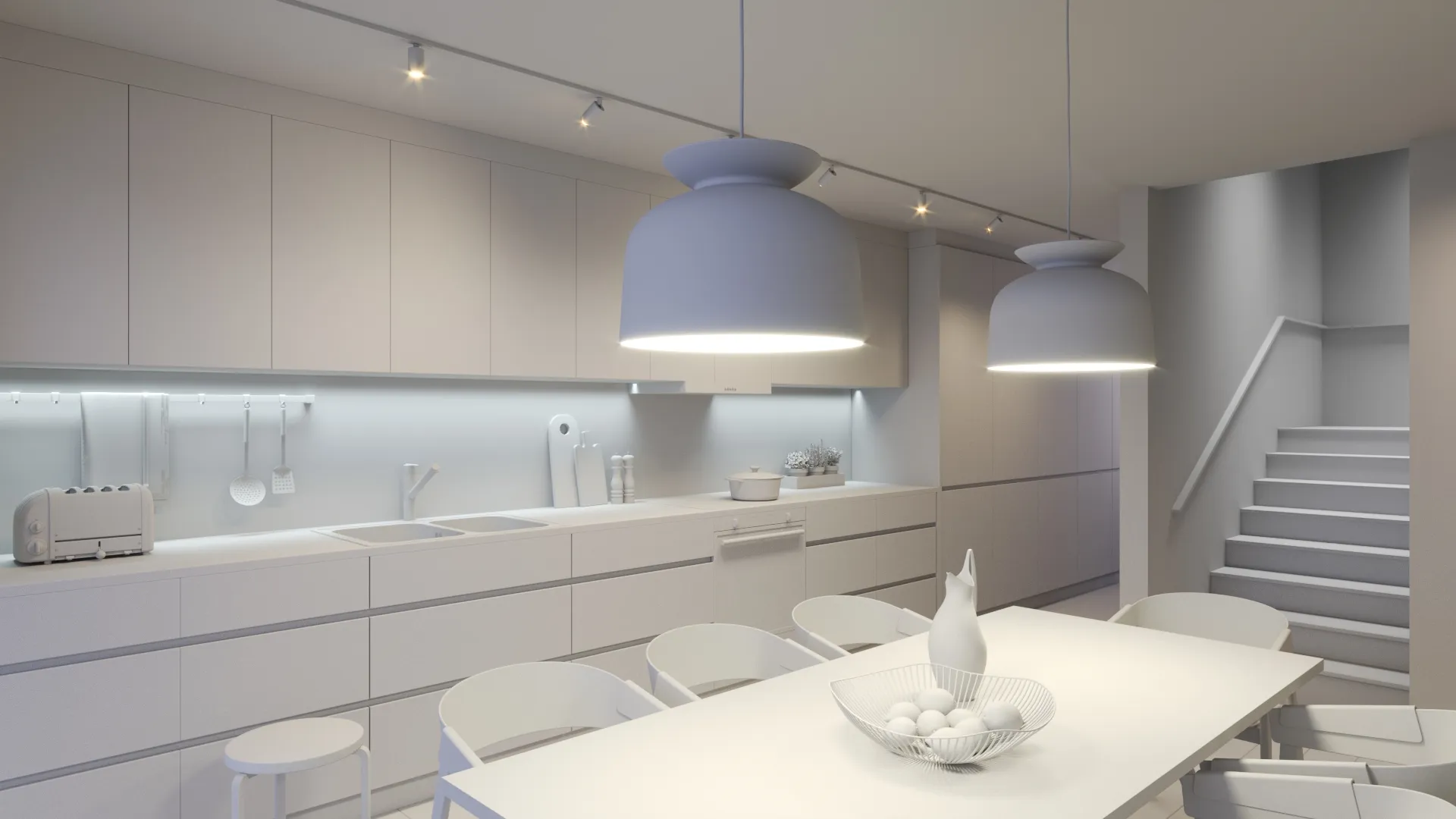
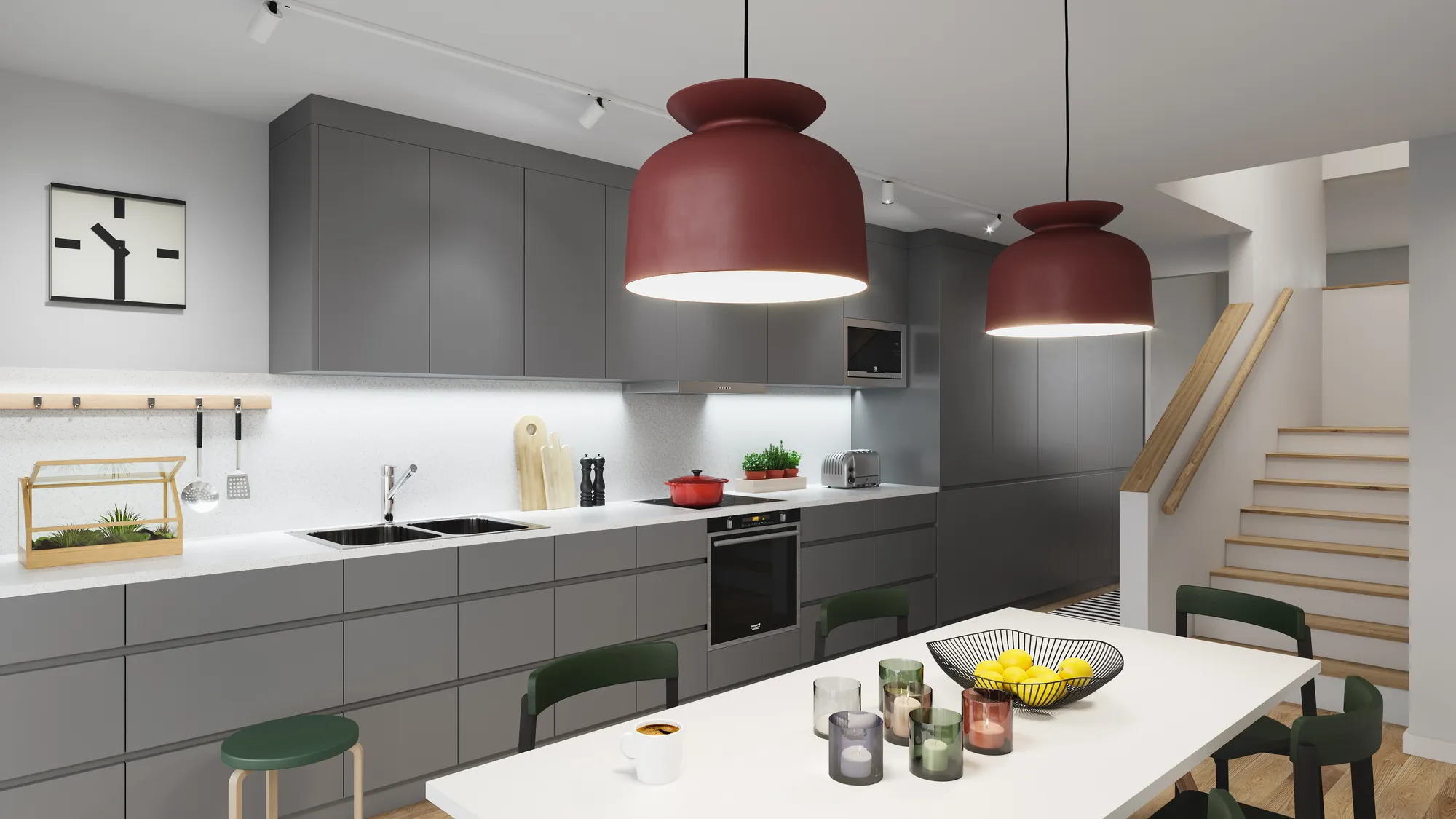
Left is the clay model of a fitted kitchen built from drawings, right is the same view with materials and lighting, the route for an off-plan unit with no room to photograph.
Using both: hybrid and partial staging
The 2 methods can share one listing. There are 3 common patterns:
- Split by room. Stage the rooms that buyers judge in person physically (living room, kitchen and dining area, primary bedroom). Stage secondary rooms virtually (second bedroom, home office, basement, balcony).
- Soft staging plus one virtual room. In an occupied home, a stager rearranges the owner’s furniture, removes clutter and adds rented accessories. Virtual staging shows an empty spare room with a clear purpose.
- Virtual first, physical later. Launch the listing online with virtually staged photos. Add physical staging only if viewings are slow.
The disclosure rules below apply to every virtually staged photo, even when other rooms in the same home are staged physically.
Which rooms to stage first
Start with the living room, the kitchen and dining area and the primary bedroom. These are the rooms buyers judge first in the listing photos. Next come rooms with an unclear purpose, such as a small spare room that can be shown as a home office or nursery, an odd-shaped corner or a loft. An empty room like that looks like wasted space until furniture shows what it is for.
What virtual staging and traditional staging involve
Traditional staging is physical work inside the property. Furniture, rugs, art and accessories are rented from a staging company, delivered by van and arranged on site by a stylist. The pieces stay in the rooms for the listing period, so anyone who walks through the door sees the same sofa and dining table that appear in the photographs. When the property sells or the listing ends, the furniture is collected and returned.
- A stylist visits the property and plans the layout room by room
- Furniture and accessories are delivered, unpacked and arranged
- The rooms are photographed once everything is in place
- The furniture stays for the viewing period, then is collected and returned
Virtual staging skips the van and the stylist visit. A photograph of the empty room is taken from a fixed position, sent to a studio or an app, and furniture is added to that image. Nothing physical enters the property, and the walls, windows and floor in the picture are exactly what the camera saw.
- The empty room is photographed from a position that shows the floor and 2 walls
- The photograph is sent to a studio, with a floor plan if one exists
- Furniture, rugs, art and light are added to that image, matched to the room’s real size
- The finished image comes back, still showing the same walls, windows and floor
How the cost of each works
Traditional staging is a recurring cost. It usually combines a design consultation, delivery and setup, rental for each month the home stays listed, and a collection charge at the end. The bill keeps running for as long as the home is on the market. A larger home needs more furniture for longer, which is the main reason a big house costs more to stage physically than a one-bedroom apartment.
Virtual staging is a one-time cost. You pay once for the photos that are staged, and a listing that takes longer to sell costs nothing extra. Most virtual staging is priced per photo, and AI apps often charge per photo or by subscription. At 3Dstudio.co, virtual staging is priced per project, as one fixed figure for the whole set, agreed before work starts. Projects start at €1,000. See how a fixed quote is worked out.
| Traditional staging | Virtual staging | |
|---|---|---|
| Cost type | Recurring, by the month | One-time |
| What makes it grow | Size of the home and length of the listing | Number of rooms and amount of clearing |
What moves a virtual staging quote at a studio:
- How many rooms need furnishing
- How much has to be cleared out of the photograph first (a tenant’s belongings or a builder’s leftovers count as their own step)
- Whether a floor plan is available to check furniture against real dimensions
- How many portal and print crops are needed
- How many schemes you want: a second scheme for a room already staged is a smaller job than the first, because the room does not have to be planned from scratch again
Tip: send every room you might want staged in one batch, with a floor plan if you have one. The quote then covers the whole set at once.
Speed and flexibility
Traditional staging needs lead time before anything happens. Furniture has to be available, a delivery slot has to be booked and a stylist has to be free, so the property is often empty for a stretch before staging day. Changing the look once the furniture is in place means a second delivery and a second stylist visit, so a staged home usually keeps one look for the whole listing.
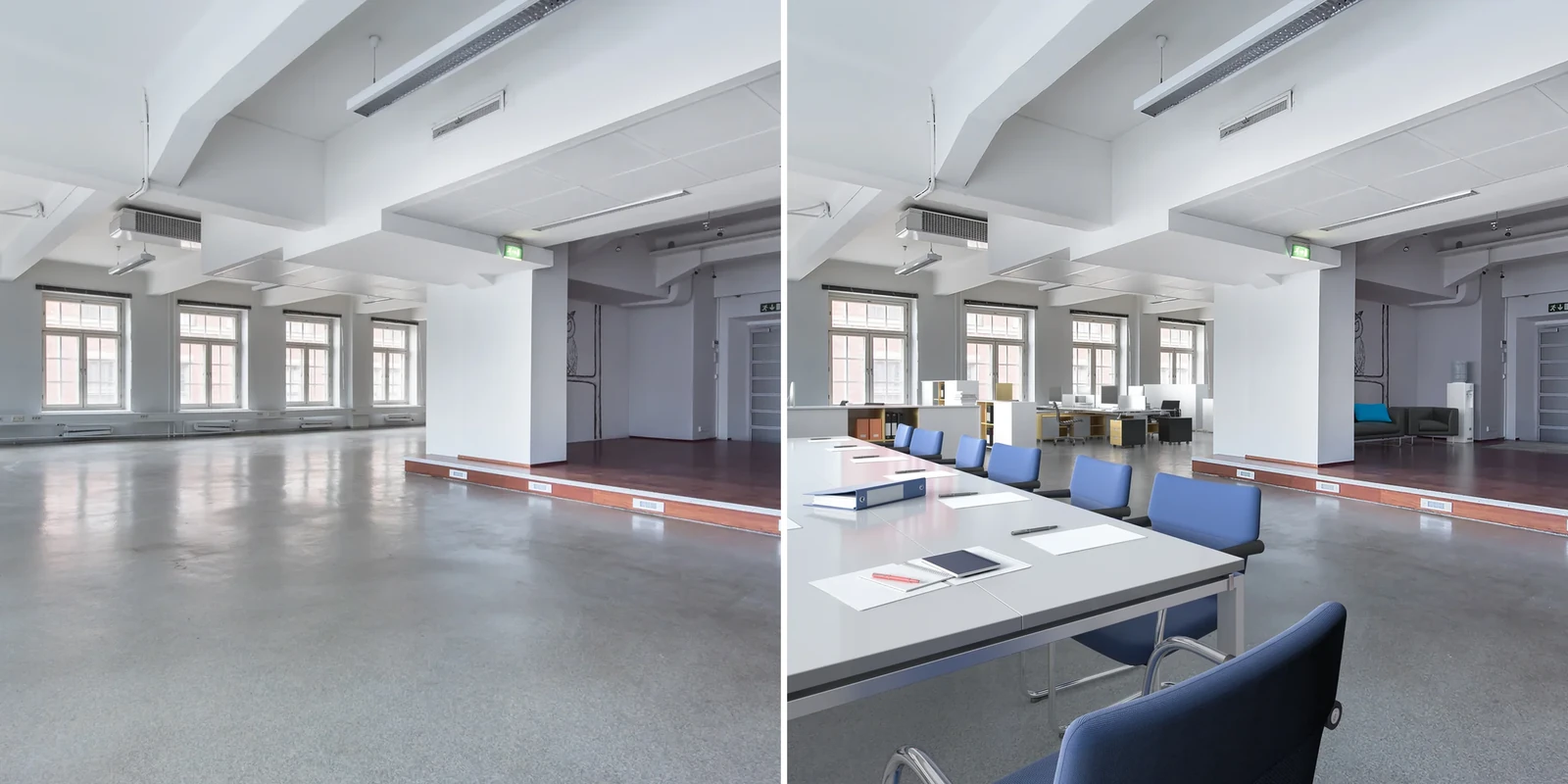
AI apps return a staged photo in seconds. A studio that places furniture against a floor plan takes days rather than weeks for a photographed room, and at 3Dstudio.co the delivery date is fixed with the quote. Virtual staging also allows changes that physical staging does not. The same empty photograph can be furnished more than once, with a different scheme for a family, a young professional or an investor, without any furniture being moved. A meeting room or an open-plan office can be shown furnished the same way. This helps a tenant see how many desks or seats the room holds before booking a viewing.

An empty office photographed and staged as a meeting room, from the same camera.
Vacant homes vs occupied homes
A vacant home can use either method. In an occupied home, a stager usually works with the owner’s furniture: removing clutter, rearranging pieces and adding rented accessories. A tenanted home is harder, because the tenant’s furniture and daily life stay in the rooms.
Virtual staging clears and refurnishes the photograph instead. Clearing is its own step: temporary items such as boxes, a ladder or a tenant’s furniture are removed from the image, and the real belongings stay where they are. Fixed features are never removed. This makes virtual staging workable for a tenanted apartment, an owner living abroad or an owner who will not pay for furniture before a sale.
What buyers see at the viewing
A traditionally staged home looks the same at the viewing as in the photos. A virtually staged home is usually empty, because the furniture only exists in the image. A buyer who finds bare rooms behind furnished photos can feel misled. These 5 steps help:
- Show the staged photo and the empty original side by side in the listing.
- Print each staged image and leave it in that room for the viewing.
- Keep the images on a tablet for open houses.
- State in the listing text which rooms are virtually staged.
- Choose furniture that fits the room’s real size, so a buyer who measures is not misled.
A 3D floor plan next to staged photos shows the layout honestly. What keeps virtual staging honest is what it does not touch: the camera position, walls, windows and floor stay as photographed. Nothing structural moves. A wall is not straightened, a radiator is not deleted and a room is not widened. If you are an agent, see how we work with real estate agencies.
Disclosure rules for virtually staged photos
Since 1 January 2026, California requires real estate licensees to state when a listing photo has been digitally altered, including virtual staging, and to make the original photo available. Other rules differ by country and by portal:
- United States, Realtors (NAR members). Article 12 of the NAR Code of Ethics requires a true picture in advertising and marketing. Labeling a virtually staged photo is how agents keep it true.
- California, AB 723. The photo needs a reasonably conspicuous statement that it has been digitally altered when furniture, fixtures, flooring, wall color, landscaping or views are added, removed or changed. Lighting, exposure, color correction, cropping and straightening do not count as altering. The unaltered original must also be posted, or linked, on websites the agent or broker controls. See this summary of the rule from a California Realtor association.
- MLSs and portals. Many have their own wording, and some ask for the original photo next to the staged one. Read the rules of the platform before you upload.
- Outside the United States. Misleading property advertising falls under general consumer protection law. Check the portal’s rules and use the wording it expects.
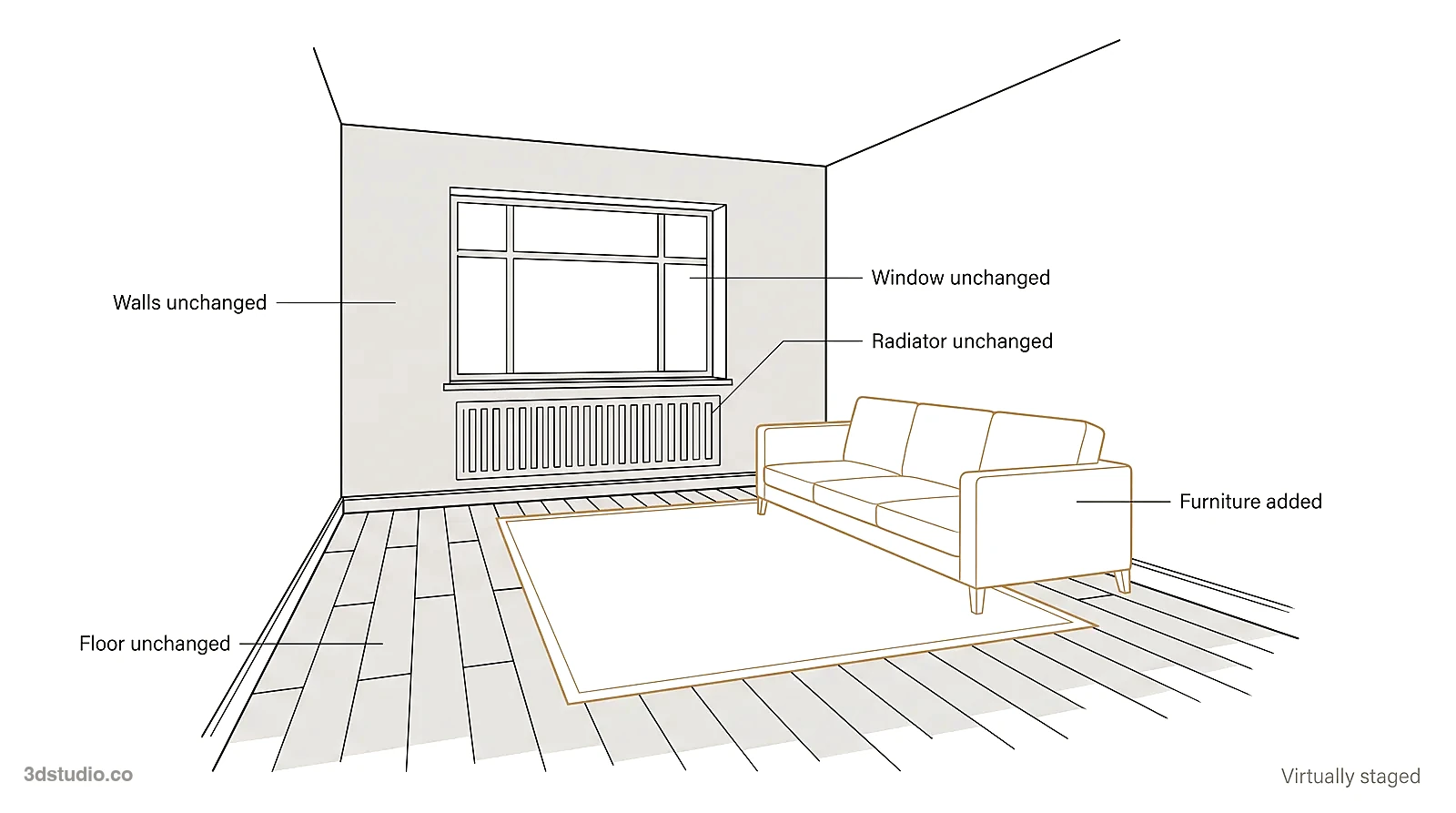
In practice, this means 3 things. Keep the empty original of every staged photo. Publish it next to the staged one wherever a rule requires it. Never alter fixed features. This is general information, not legal advice, so confirm the wording with your broker or listing platform.
3Dstudio.co delivers a copy captioned as virtually staged, in wording a portal or listing board can use. The walls, windows and floor stay as photographed. The empty original is the photograph you sent, so keep it with the set. Traditional staging needs no label, because the furniture in the photograph is the furniture in the room.
AI virtual staging apps vs a studio
Virtual staging now comes in 2 forms. Self-serve AI apps return a furnished image in seconds to minutes, priced per photo or by subscription. A studio service has a person place the furniture. At 3Dstudio.co, that person checks the scale against the room and leaves the walls, windows and floor as photographed.
Apps are good for fast drafts, for trying styles and for low-stakes rentals. Depending on the app, the room’s proportions and the furniture scale can drift, and fixed features such as window shapes, flooring or wall openings can change. That turns a staged photo into a misleading one under the disclosure rules above.
| Question | AI app | 3Dstudio.co |
|---|---|---|
| Speed | Seconds to minutes | Days rather than weeks, date fixed with the quote |
| Pricing | Per photo or subscription | Per project, one fixed price for the set |
| Furniture checked against the room’s real size | Usually not | Yes, against a floor plan when one exists |
| Walls, windows and floor | Can change without notice | Left as photographed and checked by a person |
| Best for | Drafts and low-stakes rentals | Listings where the photo must match the room |
How to tell good virtual staging from bad
Run these 8 checks on any staged photo, whether it comes from an app or a studio:
- Scale. Compare the furniture with the doors and windows. A sofa back that reaches half the height of a door is too big.
- Contact shadows. Every leg and the edge of every rug has a soft shadow on the floor.
- Light direction. Shadows fall away from the windows, as they do in the empty photo.
- Perspective. Furniture lines follow the same vanishing lines as the room.
- Rugs. A rug lies flat and follows the floor.
- Fixed features. Furniture may stand in front of a radiator, socket or beam, but nothing is painted out of the photo.
- Consistency. All rooms of one listing share the same style and light.
- The original. The empty photo still matches the staged one: same camera, walls, windows and floor.
The meeting room pair earlier in this guide is a worked example. The 4 windows, the ceiling panels and the grey carpet are the same in both photos. The radiators under the windows are still visible behind the table and chairs. Only furniture is added: a table, chairs, a whiteboard, a storage cabinet and 2 plants.
What to send for virtual staging
The source photo limits how good the staged image can be. Send 5 things:
- One photo per room at full resolution, taken level from about chest height (a tripod helps, a phone works)
- Vertical lines kept straight, so walls do not lean
- All lights on and blinds open
- The floor and at least 2 walls in frame
- A floor plan if one exists, a note on which rooms need clearing first, and who the home is being sold or rented to
You get full usage rights to every delivered image. Upload the photos for a virtual staging quote, or read how the quote and delivery work.
Questions about virtual staging vs traditional staging
Is virtual staging worth it for an empty home?
Yes for a vacant home marketed mainly online. An empty room gives no sense of scale in a photo, and virtual staging is a one-time cost. It is worth less when most buyers will walk through, because they find the room empty. In that case use the hybrid approach.
Do you have to disclose virtual staging in a listing?
Yes. NAR Code of Ethics Article 12 requires a true picture, and California AB 723 requires a statement that the image is digitally altered, plus the original photo, since 1 January 2026. Many MLSs and portals add their own wording. Keep the empty original of every staged photo. See the disclosure rules above.
Do real estate agents use virtual staging?
Yes, mainly for vacant listings, rentals and homes where physical staging is not practical. Many start with the main rooms: the living room, the kitchen and dining area and the primary bedroom. For each staged photo they also need a labeled copy and the empty original, to meet the disclosure rules.
How much does it cost to virtually stage a house?
It depends on the pricing model. Apps and many services charge per photo, and a studio can quote per project. At 3Dstudio.co the price is one fixed figure for the set. It moves with the number of rooms, the clearing, whether there is a floor plan, the crops and the extra schemes. See pricing.
Can AI virtual staging replace a studio?
For quick drafts and low-stakes rentals, often. An app does not check furniture against the room’s real size and can change fixed features such as windows or flooring, which makes the photo misleading. A studio checks the result against the room.
Why does some virtual staging look fake?
The usual causes are wrong furniture scale, missing contact shadows, light from the wrong direction and perspective that does not match the camera. Use the 8 checks above to spot them.
Does virtual staging work on a room that already has furniture in it?
Yes, once it has been cleared in the image. Clearing is quoted as its own step: boxes, a ladder or a tenant’s furniture are removed from the photograph before the new furnishing is added. Fixed features are never removed. More questions are answered on our FAQ page.
Diagrams in this post are drawn with an AI image tool from our brief and checked by our team.